Sill emplacement and magma storage
I compare discrete sill injections with a distributed heat source. The resulting thermal histories help me calculate zircon ages and distinguish storage from eruptive regimes in the models.
01 / Research
My research interests center on the evolution of magmatic systems, from repeated sill injection to central-vent caldera collapse. I use one-dimensional thermal models, two-dimensional thermo-mechanical models, and GPU-capable Julia code to study different parts of that problem.
I compare discrete sill injections with a distributed heat source. The resulting thermal histories help me calculate zircon ages and distinguish storage from eruptive regimes in the models.
My published models follow magma withdrawal through a central vent. Chamber geometry affects whether the roof subsides as a block or breaks along radial faults, and how much pressure must fall before failure.
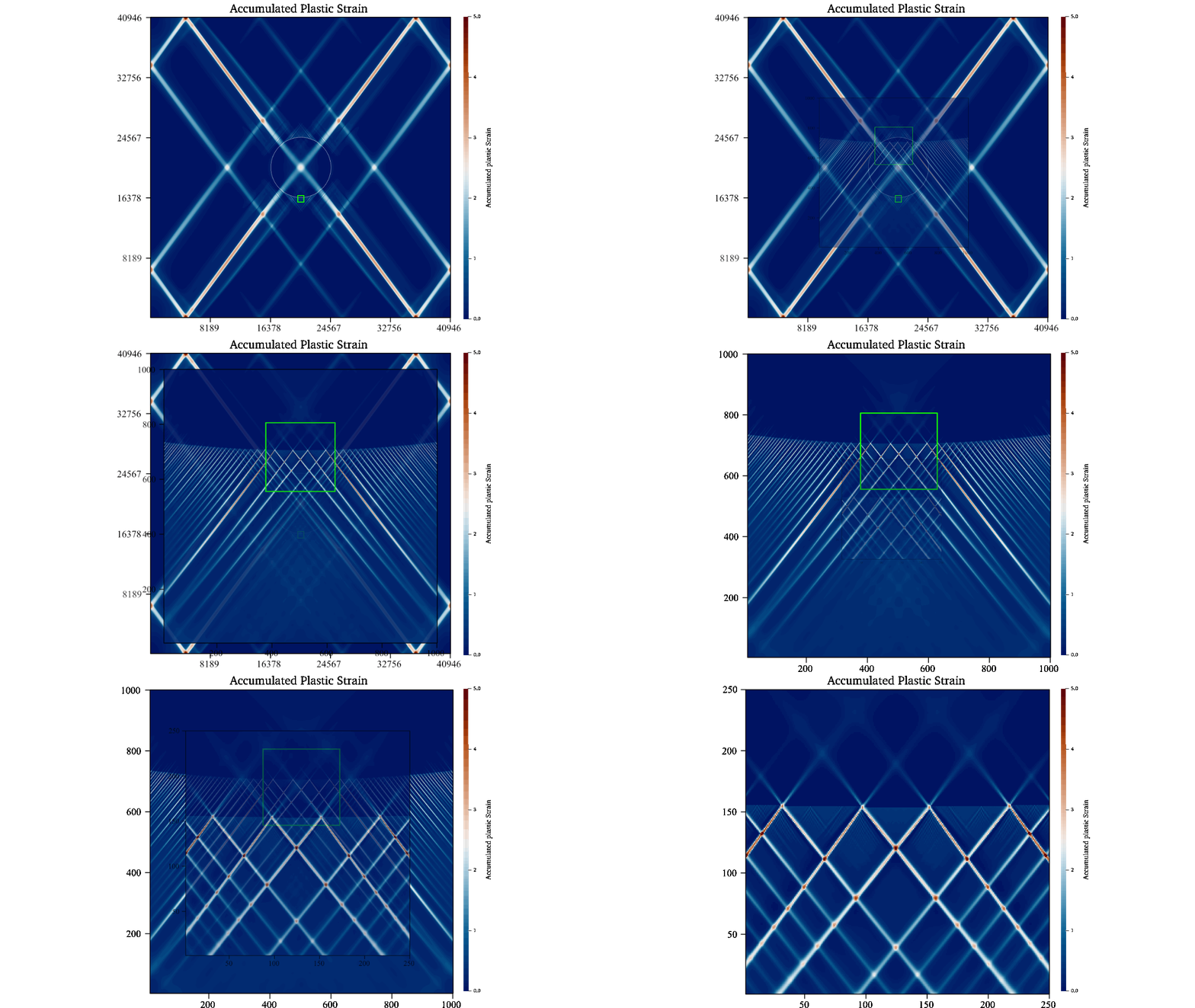
I test whether simulated faults change as the grid gets finer. In a 40,946 × 40,946-cell model, major shear bands persist while smaller features appear as the rock starts to yield.
I co-develop JustRelax.jl, the Julia framework behind the caldera and shear-band models. I also contribute to GeophysicalModelGenerator.jl and GeoParams.jl.
Caldera collapse model
This supplementary animation from my caldera paper shows the chamber and surrounding crust deforming as magma is withdrawn.
Shear-band model
This animation zooms into my 40,946 × 40,946-cell model of shear-band formation. I use it to examine the small faults that develop when the rock begins to yield.